


Poker face cards are the jacks, queens and kings of a standard 52-card deck. They are named after the human figures printed on them, and older sources call them court cards or picture cards.
These cards are older than poker itself. Playing cards reached Europe from the Mamluk Sultanate in the late 14th century, and the original court cards there showed titles and patterns instead of people. European makers replaced them with kings, knights and valets. Around 1480, French makers introduced the hearts, diamonds, clubs and spades still used today. English makers later simplified the French figures into the stylised portraits found on most decks now. Poker appeared in the United States in the early 19th century with a 20-card deck and later moved to the full 52 cards.

How Many Face Cards Are in a Standard Deck?
A standard deck has 12 face cards, three in each of the four suits:
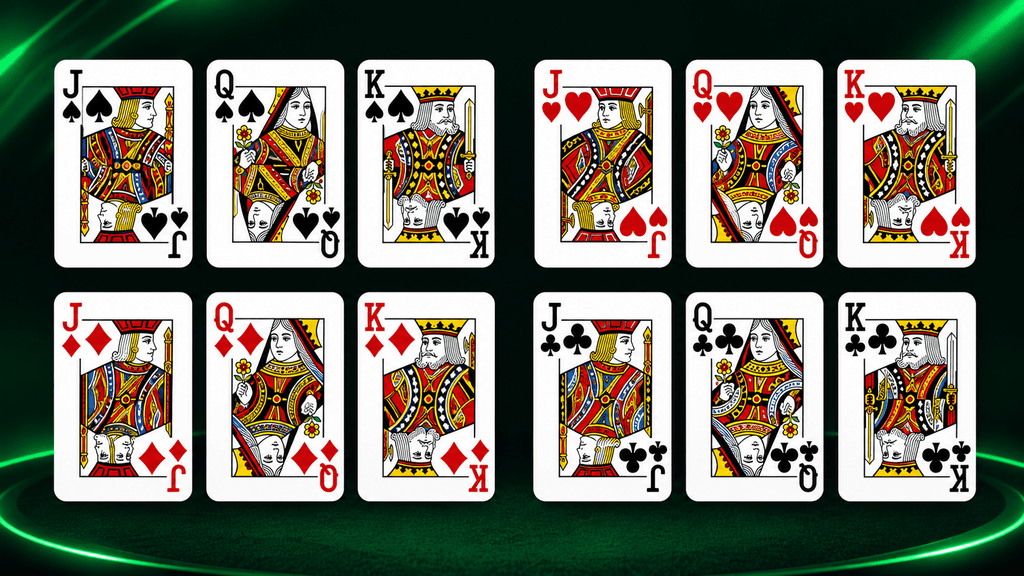
These 12 cards make up about 23% of the deck. The ten often gets mistaken for one because it belongs to the broadway cards, but by the definition of what is a face card it doesn’t qualify. In Texas Hold’em, a player gets at least one face card among the two hole cards about 41% of the time. Two face cards arrive in roughly 5% of hands. In Omaha, where each player gets four hole cards, the chance of at least one face card rises to about 66%.
Modern face cards are double-headed, so the figure reads the same from either side of the table. Their corner indices show J, Q and K, which makes them easy to spot in a fanned hand.
Is an Ace a Face Card?
Many players ask is ace a face card because it ranks above the king. It isn’t: the ace shows a single large pip instead of a person, so a hand like A-K holds one face card, not two.
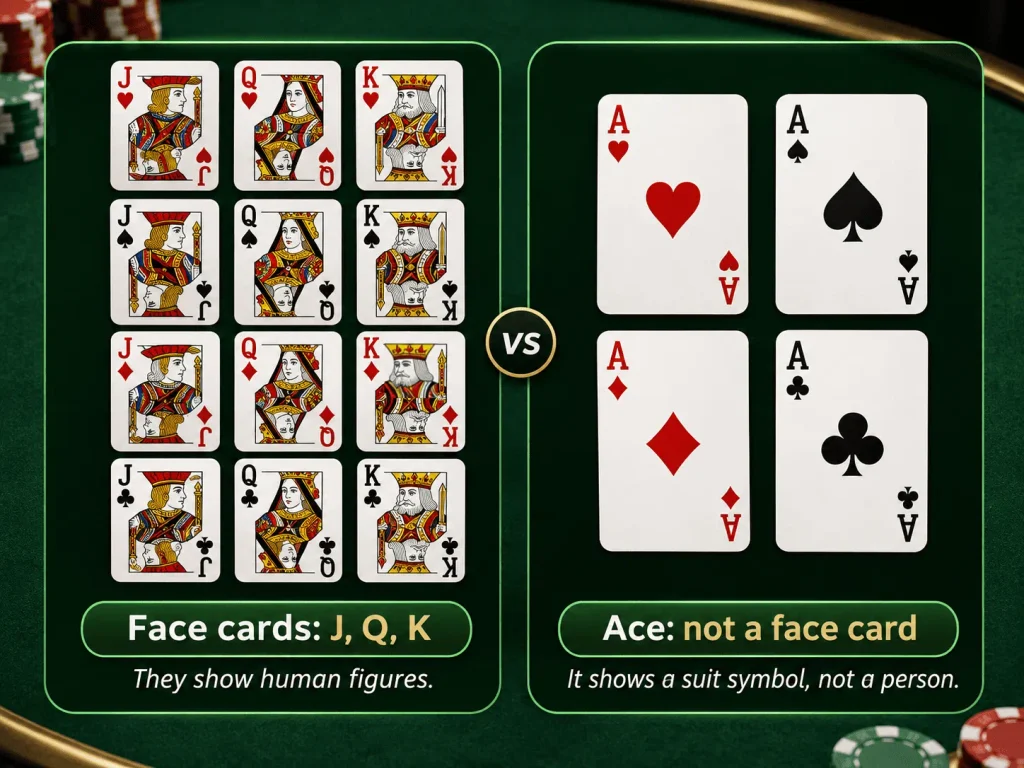
In poker, the ace plays both high and low. It tops the A-K-Q-J-10 straight and sits at the bottom of A-2-3-4-5, a straight known as the wheel. You can read more about its role in Ace in Poker.
Does an ace count as a face card in other games? No, and blackjack shows the difference clearly: the ace counts as 1 or 11 instead of a fixed 10.
Face Card Values in Poker
Poker face cards carry no point values, and only rank matters. In blackjack, knowing what is a face card tells you its value at once, since each counts as 10, while baccarat counts them as zero. The order runs from the ace down through K, Q, J and 10 to the two. The king is the highest face card poker recognises, while the ace sits above it as a separate rank. Suits don’t matter when comparing hands, so K♠ and K♥ are equal. The only common exception is the draw for the dealer button, where spades, hearts, diamonds and clubs break ties in that order. Here is what each face card means in Hold’em:
- King (K): pocket kings beat a random hand about 82% of the time, and at least one ace lands on the flop in roughly 23% of hands.
- Queen (Q): pocket queens win about 80% against a random hand, but an ace or king flops in around 41% of hands.
- Jack (J): pocket jacks win about 77% against a random hand, yet at least one overcard flops roughly 57% of the time.
Face cards also work as kickers. When two players share the same pair, the next-highest card decides the pot, so a king kicker beats a queen kicker.
How Do Face Cards Affect Poker Hands?
Face cards form the top of most combinations in the Poker Hands rankings. A royal flush includes all three face cards of that suit. The same ranks in mixed suits make the broadway straight, the highest straight possible. Within the same hand type, face cards also win ties: kings full of fives beat jacks full of aces, because the three-card part decides.
Poker face cards make up most premium starting hands. Each specific pocket pair, such as K-K, arrives once in 221 hands, so K-K, Q-Q or J-J together show up in about 1.4% of deals. Besides pocket pairs, hands like K-Q, K-J and Q-J can make top pair, straights and, when suited, flushes. They also have a weakness: K-J offsuit wins only about one hand in four against A-K. Kings and queens are the face cards poker beginners overvalue most when facing big raises.
K-4 offsuit is a typical weak face card poker hand. It often pairs the king, then loses to any opponent holding a king with a better kicker.
On later streets, a face card can change the hand completely. If you hold 9-9 on a 7-5-2 flop, a king on the turn gives every K-x hand a better pair. A queen or jack on the river can also complete straights like Q-J-10-9-8 for players holding high connected cards.
Board texture matters too. Flops like K-Q-7 favour the preflop raiser, whose range holds more high cards than a caller’s range. Position changes the picture as well: the same face cards poker players open from the button are often folds under the gun.