




If you are fairly new to studying poker, reviewing visual grid materials is the most efficient method to build a profitable foundation. Many beginners rely purely on intuition during the initial betting round, resulting in frequent postflop traps and avoidable chip losses. Incorporating structured poker preflop charts into your daily study routine removes guesswork by assigning proven preflop actions to every starting hand. Moving from subjective decision-making to a disciplined strategy stabilizes your win rate across live cash games, online rooms, and tournaments.
This guide covers how to read grid layouts, memorize position-specific ranges, adapt to stack sizes, and avoid standard beginner errors.

What Are Preflop Poker Charts?
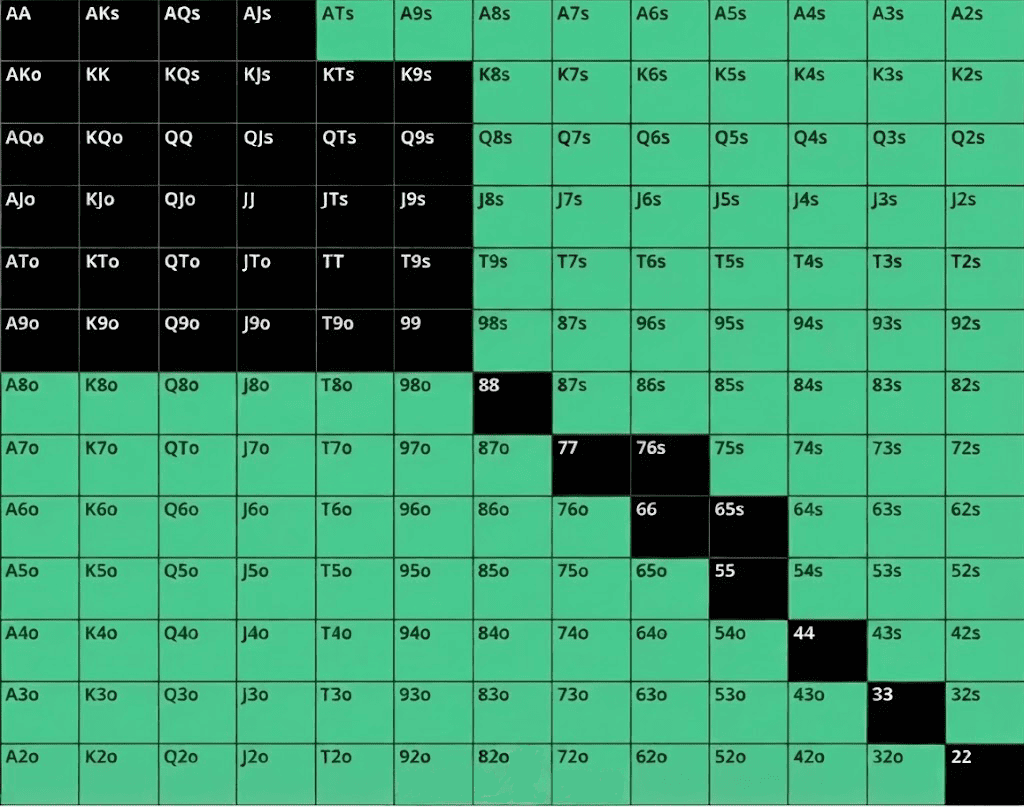
A preflop chart is a visual grid displaying all 169 unique starting hand combinations in Texas Hold’em alongside action choices like raise, call, or fold. Earlier poker theories relied on basic grouping systems, such as the Sklansky hand tiers, to categorize starting card strength in broad lists. Modern poker study uses a 13×13 color-coded matrix as the industry standard for mapping precise mathematical actions to specific table seats.
Utilizing a poker preflop range chart guarantees that your preflop strategy stays aligned with solid game theory principles across every session.
How to Read a Poker Preflop Range Chart?
Understanding a standard poker hand chart pre flop matrix requires recognizing how pairs, suited hands, and offsuit hands are organized inside the 13×13 grid layout:
- Diagonal Line (Pairs): Running from the top-left corner to the bottom-right corner, this diagonal line contains all 13 pocket pairs (AA down to 22).
- Upper Right Section (Suited Hands): All hand combinations listed above and to the right of the pair diagonal represent suited holdings, indicated by an s suffix (e.g., AKs).
- Lower Left Section (Offsuit Hands): All hand combinations situated below and to the left of the pair diagonal represent offsuit holdings, marked with an o suffix (e.g., AKo).
Color coding assigns clear tactical actions to every cell: red usually signals a raise, green indicates a call, and blue or grey marks a fold.
How To Use Preflop Charts?
Applying a pre flop range chart effectively involves studying matrix layouts away from the table to refine your decision-making. Rather than using matrices as rigid mandates, view them as baseline recommendations that ensure your opening ranges stay balanced. As you gain experience, adjust these baseline ranges based on opponent tendencies, stack sizes, and current table dynamics.
How To Memorize Preflop Poker Charts?
Memorizing every individual grid cell across nine positions is unpractical; instead, focus on pattern recognition and hand tiers:
- Group by Hand Categories: Learn where specific hand groups (such as premium pairs, suited broadways, or suited connectors) transition from folds to raises across positions.
- Focus on Threshold Hands: Remember the weakest playable hand for each position, such as identifying A8s as the cutoff boundary for suited Aces from early position.
- Use Interactive Trainers: Practice with digital preflop drills to turn range recognition into a quick, consistent habit.
Texas Holdem Poker Preflop Charts by Position
Positional location dictates your preflop strategy: as your seat moves closer to the dealer button, your opening range expands significantly. Players in early position must play tighter ranges due to remaining opponents, while late positions allow for aggressive steals.
For instance, in live 9-max cash games, an UTG range covers roughly 10.2% of hands compared to 40.8% on the Button; in online 6-max games, an UTG open covers around 18.5% versus 43.1% on the Button. Reviewing targeted preflop poker charts clarifies these strategic adjustments across all table locations.
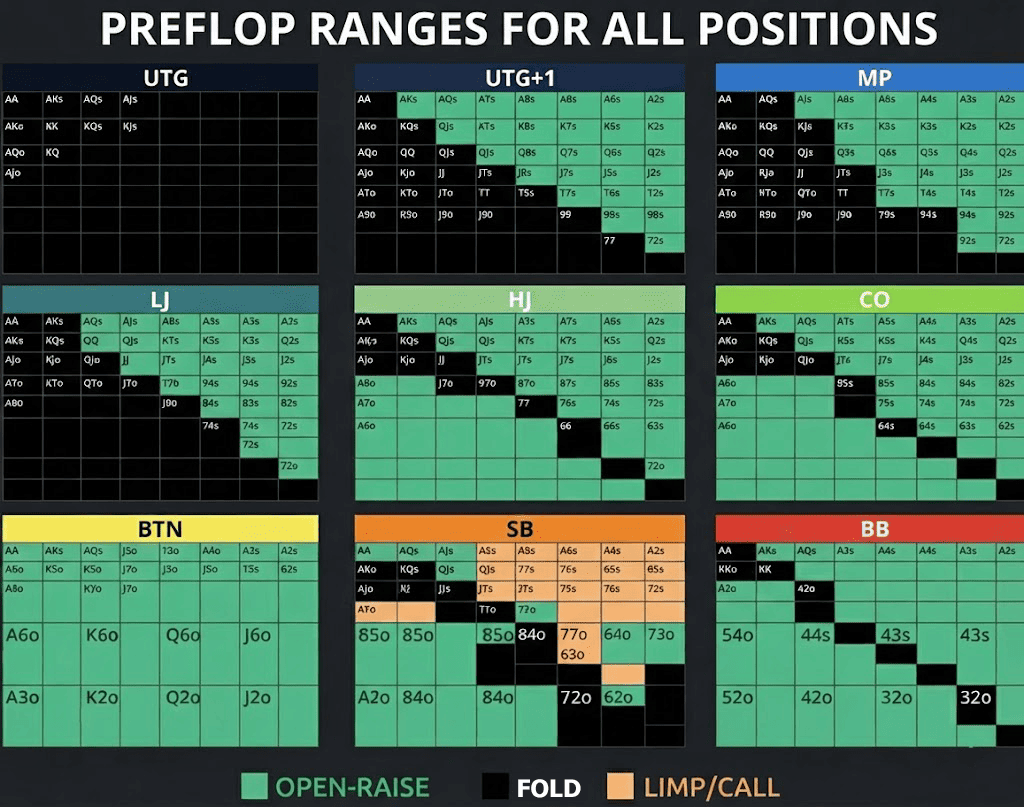
UTG |
Requires the tightest opening selection because eight players act behind you. Focus strictly on premium pairs, strong broadways, and top suited combinations. |
UTG+1 |
Allows for a minor range expansion compared to UTG, adding a few suited connectors and medium pocket pairs into your raising range. |
MP |
Middle Position benefits from folded early action, allowing you to open suited broadways and suited connectors more comfortably. |
LJ |
The Lojack position acts as the bridge between middle and late position, expanding open-raising ranges to include suited gappers and additional offsuit broadways. |
HJ |
The Hijack represents an effective blind-stealing seat where you can open a wide selection of suited holdings and offsuit broadways if early seats fold. |
CO |
The Cutoff is a strong position that allows for an aggressive opening range covering suited cards, offsuit broadways, and speculative connectors. |
BTN |
The Button is the most profitable seat at the table, allowing you to open up to 45% of dealt hands to steal blinds and ensure postflop positional advantage. |
SB |
The Small Blind calls for a wide opening range when action folds to you, but facing raises requires a strict 3-bet or fold strategy due to playing out of position postflop. |
BB |
The Big Blind focuses on defense rather than opening, using pot odds to defend with calls or 3-bets, which makes reading a BB matrix different from other seats. |
Poker Tournament Preflop Charts
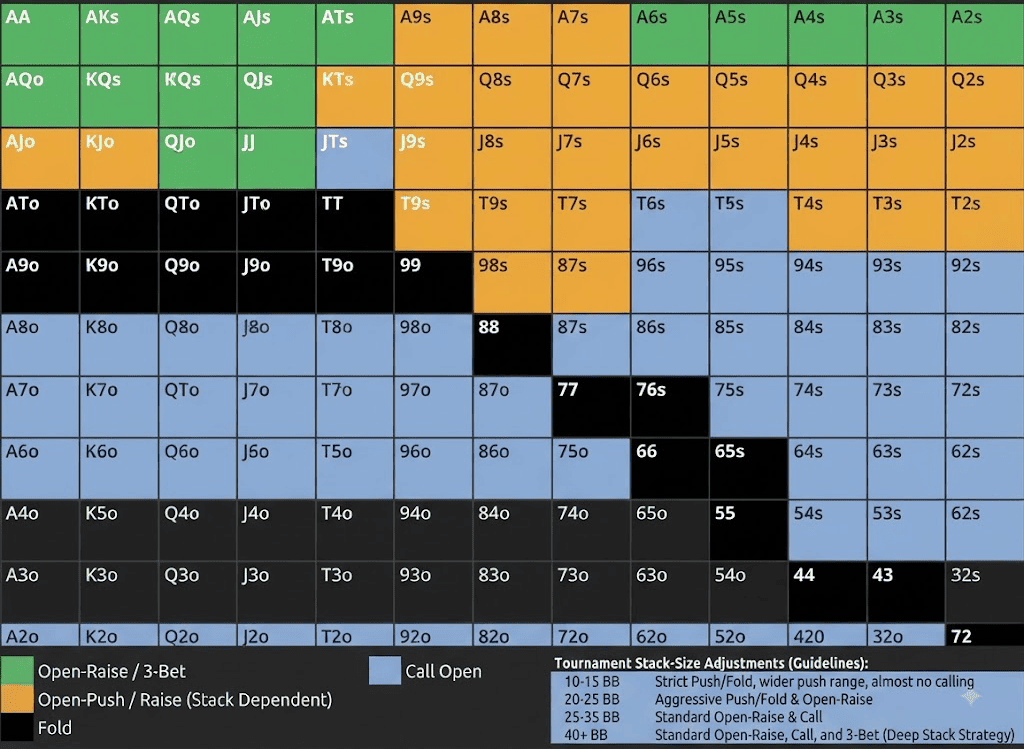
Standard cash game matrices often fail in MTT scenarios because tournament play involves shorter effective stacks, mandatory ante bets, and ICM considerations. Short stacks between 10bb and 20bb alter strategy, making push or fold charts essential for making mathematically sound decisions. Utilizing specialized poker tournament preflop charts ensures you account for stack depth, blind pressure, and payjump considerations.
5 Common Mistakes when Using Preflop Charts
Using ranges incorrectly can create major strategy leaks during live or online play:
- Referencing Charts Live at the Table: Looking at reference sheets during active play violates casino and cardroom rules of poker.
- Applying 6-Max Matrices to 9-Max Tables: Using 6-max opening ranges from early position in a 9-max game leads to overplaying weak holdings.
- Following Matrix Grids Blindly: Failing to adjust opening ranges against passive or overly aggressive opponents wastes exploitation opportunities.
- Ignoring Stack Depths: Playing a 100bb cash range when sitting on a 25bb tournament stack causes costly postflop errors.
- Neglecting Postflop Execution: Memorizing preflop actions without a structured plan for postflop streets leaves you vulnerable on complex boards.
Conclusion
Integrating texas holdem poker preflop charts into your routine eliminates preflop errors and establishes a consistent, disciplined poker strategy. Understanding positional ranges, adapting to tournament stack depths, and avoiding rigid execution protects your bankroll over the long haul. Building a strong preflop base simplifies postflop play and improves overall decision-making at the table.
To explore advanced positional strategies and refine your game, check out the training guides available at the Poker Academy.