



Dealing Texas Holdem follows a fixed sequence: shuffle, button and blinds, hole cards, four betting rounds, showdown and pot. The dealer also burns cards, keeps the action in order and settles disputed situations. This guide explains how to deal Texas Holdem poker step by step, with the rules for each stage and fixes for common mistakes.
Getting Ready to Deal Texas Hold’em
A home game needs the following equipment before the first deal:
- A standard 52-card deck without jokers, plus a spare deck with a different back color
- Chips in three or four denominations, split into equal starting stacks
- A dealer button that marks the dealer position
- A cut card to hide the bottom of the deck
- A table with room for every stack, ideally with a felt or poker mat
- Optional extras: blind buttons and a timer for tournament levels
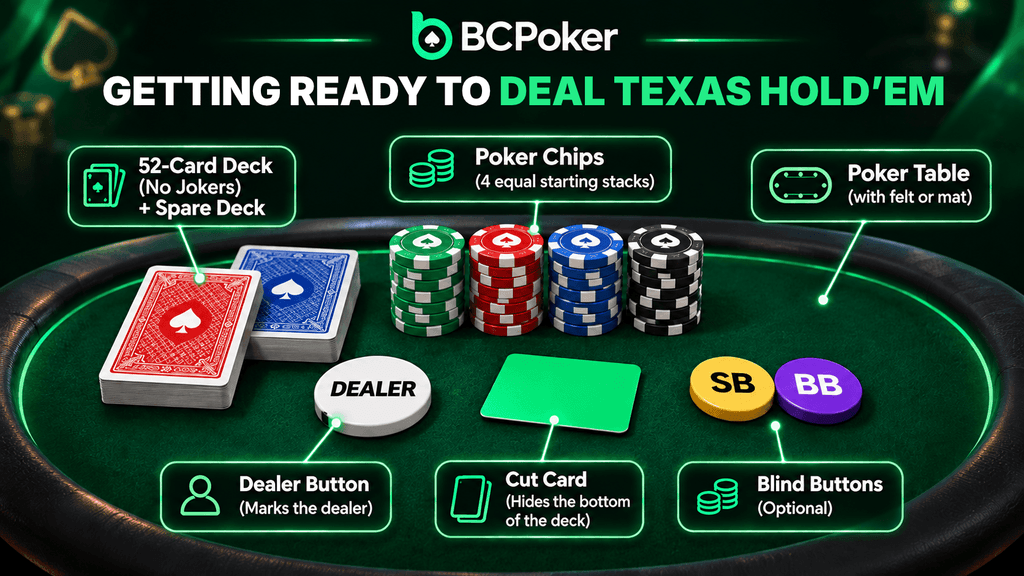
This kit covers both cash games and home tournaments, so it’s all you need to learn to deal poker and run a full session.
Step 1: Prepare the Table and Deck
Preparation covers four things: the deck, the chips, the button and the shuffle.
Check the Cards
Spread the deck face up and confirm all 52 cards are there, with no jokers or duplicates. Repeat this whenever a new deck comes in or something seems wrong.
Count Out the Chips
Give every player an identical starting stack built from the same mix of denominations. Towers of 20 chips make totals easy to read at a glance.
Place the Dealer Button
Keep the button at the edge of the table until the first dealer is chosen. From then on, it sits in front of the dealing seat.
Riffle, Strip and Cut: The Shuffle Routine
A new deck comes in perfect order, so start with a wash: spread the cards face down and mix them across the felt. After that, casino dealers use a fixed sequence of two riffles, a strip, one more riffle and a single cut. Mathematicians Bayer and Diaconis showed that about seven riffles fully mix a deck, so add rounds if your riffle is loose. A few rules keep every shuffle clean:
- Hold the deck low and close to the felt, so no card face flashes
- Protect the bottom card with a cut card
- Cut once and complete the cut on the table, never in the air
- Offer the cut to the player on your right in a home game
- Restart the routine if a card turns face up mid-shuffle
These core Texas Holdem dealer rules apply before every hand, not only at the start of the session.
Step 2: Set the Dealer Button and Post the Blinds
The button decides who posts the blinds and who acts last on the flop, turn and river.
Choose the First Dealer
After shuffling, deal one card face up to each player. The highest card wins the button, and aces count high. If two players tie, the suit decides: spades rank first, then hearts, diamonds and clubs. With A♠ and A♦ on the table, the ace of spades takes the button. Collect these cards and reshuffle before the real deal.
Identify the Small and Big Blinds
The player directly to the left of the button posts the small blind. The next player clockwise posts the big blind, usually double the small one. In a 1/2 game, that means one chip and two chips before any cards come out. After every hand, the button moves one seat clockwise, and the blinds move with it.
That rotation is how to deal in Texas Holdem fairly over a long session, since everyone pays the forced bets equally.
Step 3: Deal the Hole Cards
Start with the small blind and pitch one card face down to each player, moving clockwise. Then go around again, so every seat holds two hole cards. The button always receives the last card. Keep each card low and slide it across the felt instead of tossing it. The basic principle of how to deal a poker hand is one card at a time, never two in a row to the same player.
After the hole cards, the hand moves through four betting rounds. Before each new set of community cards, burn the top card face down.

Step 4: Finish the Hand
Knowing how to deal a poker hand to its finish means covering two outcomes: everyone folds to one player, or the hand reaches showdown.
If everyone folds except one player, that player wins the pot at once and doesn’t have to show any cards. Gather the folded hands into the muck face down.
At showdown, the last player who bet or raised on the river shows first. If the river was checked around, the first active player to the left of the button turns over first. Each player makes the best five-card hand from two hole cards and five board cards, using both, one or none of their own. A player may muck a losing hand unseen, but that gives up any claim to the pot. Read every tabled hand aloud, because standard Texas Holdem dealer rules say the cards speak.
Step 5: Award the Pot
Once the winner is clear, announce the result, for example “Queens full of sevens wins,” and push the chips over. Leave the winning cards face up until the pot leaves the middle, so players can verify the result.
If two or more players hold hands of equal value, split the pot evenly between them. An odd chip goes to the first winner to the left of the button. When side pots exist, award them before the main pot.

To prepare for the next round:
- Collect every card and check that the deck is complete
- Move the dealer button one seat clockwise
- Make sure the new blinds are posted
- Shuffle and cut before the next deal
In home games, dealing Texas Holdem usually rotates with the button, so the deck passes to the next player along with it.
Common Dealing Mistakes
and How to Handle Them
These are the most common errors in dealing Texas Holdem and the standard ways to fix them:
| Mistake 🌟 | How to handle it 📋 |
|---|---|
| 🃏 Exposed hole card | Finish the deal, give that player a replacement from the top, and use the exposed card as the first burn. |
| 🔄 Misdeal | Two exposed cards, a wrong card count or a card dealt to an empty seat means a misdeal. Collect everything, return posted chips and deal again. |
| ⚡ Premature flop | Leave the burn card in place, shuffle the three exposed cards back into the stub, cut, and deal a new flop without burning. |
| 🔥 Missed burn card | Fix it before anyone acts on that street. Once betting starts, the board usually stands. |
| 💰 Early pot push | Never move chips before every hand is read and confirmed. |
If a situation isn’t covered here, pause the hand and settle it by house rules before play continues. While you learn to deal poker, a slower pace prevents most of these errors.