



Badugi is a variant of poker, and one of the most unusual ones. It is a draw game where the lowest hand wins, and the suits of your cards matter as much as their ranks. If you know Texas Hold’em or Omaha from the BC Poker tables, Badugi will feel familiar in some parts and completely new in others.
The game is believed to come from Korea. Its name is usually linked to a Korean word that describes a black and white pattern, a nod to cards of different colors and suits. Over time Badugi made its way into online poker rooms and mixed game lineups, and it has appeared in Dealer’s Choice events at the World Series of Poker.
In this guide you will find everything a beginner needs: what the badugi card game is, the full badugi rules, a step-by-step walkthrough of a hand, a table of badugi hand rankings and some simple strategy tips for your first sessions.

What Is Badugi Poker?
Badugi poker is a four-card lowball draw game. Each player gets four cards face down, and over three draws tries to build the lowest hand with four different ranks and four different suits. Such a hand is itself called a badugi.
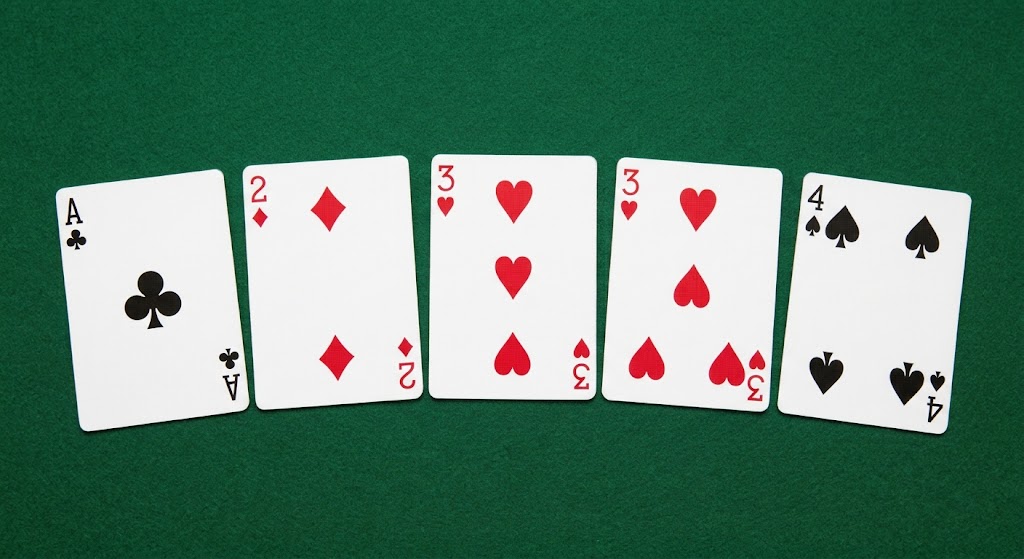
The hand above is the best possible badugi: four lowest cards, one of each suit. Aces always count as low, and straights and flushes do not exist, so they never hurt your hand.
Here is how Badugi compares with the poker most players know.
| ☑️ Feature | ⭐ Texas Hold’em | 🔥 Badugi |
| Cards per player | 2 hole cards | 4 hole cards |
| Community cards | 5 on the board | None |
| Winning hand | Highest | Lowest |
| Role of suits | Only for flushes | Every card must be a different suit |
| Changing cards | Not possible | Three draws |
| Betting rounds | 4 | 4 |
Badugi Poker Rules
The basic badugi poker rules fit into a short list. Once you understand them, the game becomes much easier than it looks at first.
- The game uses a standard 52-card deck. Each player receives four cards face down, and there are no community cards.
- Aces are low. The 2 is the second lowest card, and the king is the highest.
- Straights and flushes do not count. A run like A 2 3 4 is just four low cards.
- A card only counts if no other counting card shares its rank or suit. When two cards share a rank or a suit, only the lower one stays in your hand.
- A hand can have from one to four counting cards. Any four-card badugi beats any three-card hand, any three-card hand beats any two-card hand, and so on.
- Like Hold’em, the game uses a dealer button and two blinds. Action before the first draw starts with the player to the left of the big blind.
- There are four betting rounds and three draws. In each draw you may swap any number of cards from zero to four.
- Badugi is most often played fixed-limit. In a $2/$4 game with $1/$2 blinds, bets and raises are $2 in the first two rounds and $4 in the last two.
- If the deck runs out during a draw, the badugi rules call for shuffling the discards into a new stock.
The most important part of the badugi poker rules is counting cards correctly. These examples show how a four-card hand turns into what actually counts.
| ♥️ Cards dealt | ℹ️ What counts | 🃏 Hand |
| A♣ 2♦ 3♥ 4♠ | All four cards | Four-card badugi, 4-3-2-A |
| A♠ 2♠ 5♦ 7♣ | A♠ 5♦ 7♣ (2♠ repeats the spade suit) | Three-card hand, 7-5-A |
| 3♥ 3♣ 6♦ 9♠ | 3♥ 6♦ 9♠ (one 3 is a pair) | Three-card hand, 9-6-3 |
| A♠ 4♠ 4♥ 9♥ | A♠ 4♥ | Two-card hand, 4-A |
| K♦ 8♦ 5♦ 2♦ | 2♦ | One-card hand, 2 |
How to Play Badugi Poker: The Process
Now let’s look at how to play badugi in practice. Below we follow one player through a full hand, from the first cards to the showdown, so you can see how every round works.
Dealing the Cards and First Betting Round
The small blind and big blind post their bets, and each player receives four cards face down. Our player gets this hand:
Only three cards count here: 3♥, 7♠ and K♣, because the second 3 makes a pair. It is a three-card hand with a king on top, not strong, but with two low cards to build on.
The first betting round starts with the player to the left of the big blind. Everyone can fold, call or raise, and in a $2/$4 game the bets are $2. Our player calls.
First Draw and Second Betting Round
In turn, starting with the first active player to the left of the button, everyone decides how many cards to discard. Our player throws away K♣ and 3♦ and draws two new cards: A♣ and Q♦.
Now all four cards are different in rank and suit, so the hand is a badugi, but a rough one: Q-7-3-A. The second betting round follows, still with $2 bets, and starts with the first active player to the left of the button.
Second Draw and Third Betting Round
A queen-high badugi often loses to the lower badugis other players can make, so our player decides to break it. They discard the Q♦ and draw one card. The new card is the 5♠.
The 5♠ shares a suit with the 7♠, so only the lower spade counts. The hand is a three-card 5-3-A, very low but not yet a badugi. In the third betting round the bet size doubles to $4.
Final Draw and Last Betting Round
On the final draw our player discards the 7♠ and draws one card. It is the 4♦, the perfect fit.
The hand is now a five-high badugi, 5-4-3-A, one of the best hands possible in the game. The last betting round is played with $4 bets, and our player bets for value. One opponent calls.
Showdown
Players who are still in the hand show their cards, and the lowest hand wins. Our opponent shows A♥ 2♣ 6♠ 8♦, an eight-high badugi.
Both players have four-card badugis, so the highest cards are compared first: 5 against 8. The lower card wins, and our player takes the pot. If the hands were identical in rank, the pot would be split. Discarded cards never count at showdown.
That is the whole cycle of how to play badugi: bet, draw, bet again and compare the lowest hands.
Badugi Poker Hand Rankings
The badugi hand rankings work from the number of counting cards first and from the height of those cards second. The table lists hands from strongest to weakest.
| 🌟 Rank | ✅ Hand type | 🔻 Example | ✔️ Reads as |
| 1 | Best possible badugi | A♣ 2♦ 3♥ 4♠ | 4-3-2-A |
| 2 | Low badugi | A♣ 2♦ 3♥ 6♠ | 6-3-2-A |
| 3 | High badugi | 5♣ 8♦ 10♥ K♠ | K-10-8-5 |
| 4 | Three-card hand | A♣ 2♦ 3♥ 3♠ | 3-2-A |
| 5 | Two-card hand | A♣ 2♦ 5♦ 7♦ | 2-A |
| 6 | One-card hand | 3♠ 6♠ 9♠ K♠ | 3 |
When two hands have the same number of cards, compare the highest card first, and the lower one wins. If the top cards match, move to the second highest card, then the third. For example, 8-6-2-A loses to 8-5-4-3, because after the tied eights the 5 is lower than the 6.
The best hand in badugi is A-2-3-4 in four different suits. It cannot lose, only split the pot. Even a king-high badugi still beats the best three-card hand, which is why completing four cards is the first goal in every hand.
Basic Badugi Poker Strategy for Beginners
These tips are for players who are new to badugi poker and want to avoid the most expensive mistakes of the first sessions.
- Choose your starting hands carefully. A low three-card hand, such as 4-2-A with a fourth card to draw, is a good start. High cards and hands with many shared suits are usually not worth playing.
- Count your opponents’ draws. A player who draws three cards is far from a badugi, and a player who stands pat most likely has one already. This is the main information you get in the game.
- Do not chase with weak draws late in the hand. In the last two rounds the bets double, so calling with a high three-card hand against someone who stands pat costs a lot over time.
- Remember that not every badugi is strong. A rough badugi like Q-J-7-3 can lose to many hands that are still drawing, so sometimes it is better to break it, as in the example above.
Even the best hand in badugi will not save a player who ignores position and draws. Start with tight, simple play, and add bluffs later, once the rules feel natural.