




In poker, few moments generate as much tension as when powerful hands collide at the table. Many players, especially those still building experience, often wonder: does a full house beat a straight? The answer is clear and straightforward. A full house is considerably stronger and always wins in this matchup.
This guide explores the reasons behind this ranking, examines how frequently each hand appears, and explains what these insights mean for your strategy. Mastering this fundamental comparison helps you make better decisions and extract more value from strong situations.

Why Does a Full House Beat a Straight?
A quick look at the official poker hand rankings shows that a full house stands two levels above a straight. This placement exists for good reason. It reflects both how difficult each hand is to form and how much power it carries during actual play.
The main factor is rarity. A full house occurs less often than a straight, and that is exactly why it ranks higher. No matter the strength or composition of your straight, any full house will defeat it. This fact influences strategy on many board textures, particularly when both hands become possible.
Full houses usually need paired cards on the board, whereas straights develop from connected sequences. These different requirements affect how often each hand can be completed and how you should bet or call in various spots.
Full House in
Poker
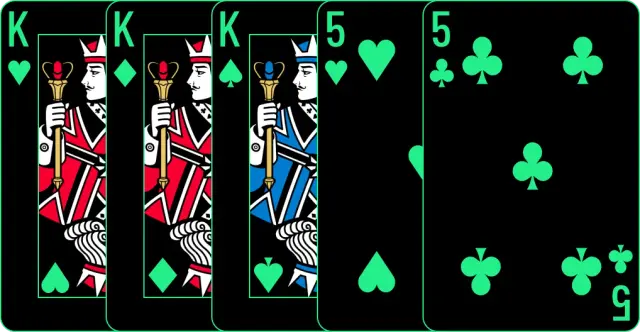
A full house consists of three cards of one rank combined with two cards of another rank. It is often referred to as a boat. A typical example would be three aces and two kings.
In Texas Hold’em this hand remains fairly uncommon. When you hold a pocket pair, the chance of flopping a full house sits around one percent, though specific board textures can improve those odds. By the river, if you flop a set you have roughly a 33 to 35 percent chance to improve to a full house or better. With two pair the odds drop to about 17 percent.
Thanks to their strength and scarcity, full houses serve as excellent value hands. They frequently win large pots against straights, flushes, and even weaker full houses.
Straight in
Poker
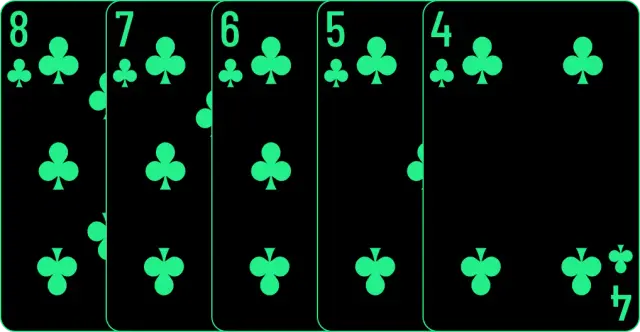
A straight is made up of five cards in consecutive order that are not all the same suit. Common examples include 7-8-9-10-J or the wheel A-2-3-4-5. The highest card in the sequence determines the overall strength of the hand.
Straights appear more frequently than full houses. With properly connected hole cards you have about a 1.29 percent chance of flopping one. Open-ended straight draws complete by the river around 34 percent of the time. Across all possible five-card combinations, straights show up nearly three times more often than full houses.
Despite their power, straights remain vulnerable on paired boards where opponents can easily hold a full house.
Examples of Full House vs Straight
Here are two practical examples that clearly demonstrate how these hands compare in real play.
Example 1:
- Player A: 7♠ 7♣ (full house)
- Player B: 9♠ 4♦ (straight: 5-6-7-8-9)
- Board: 8♠ 8♥ 7♦ 6♣ 5♥
Example 2:
- Player A: J♠ 9♥ (full house: nines full of jacks)
- Player B: Q♦ 7♣ (straight: 8-9-10-J-Q)
- Board: J♥ 10♠ 9♦ 9♣ 8♥
Result: Player A’s full house defeats Player B’s straight. Even the highest possible straight comes up short here.
These situations highlight why it is essential to watch for full house potential whenever the board shows paired cards.
Common Misconceptions about Full House and Straight
Many players still have difficulty with the full house vs straight relationship. Here are several common mistakes worth avoiding:
- Thinking that a higher straight can ever beat any full house.
- Placing too much value on straight draws when the board is paired.
- Betting too small with a full house in hopes of keeping a straight in the hand.
- Underestimating how often straights actually appear compared with full houses.
- Ignoring how board texture changes the relative value of both hands.
Removing these errors from your game will lead to better results in important pots.
Conclusion: Is Full House Better Than Straight?
Yes, a full house is better than a straight in every situation. This remains one of the basic rules every poker player needs to know by heart.
The higher ranking, combined with greater overall strength, makes the full house a hand capable of winning substantial pots. Learning to confidently navigate does a full house beat a straight in poker situations gives you a strong foundation for improved play and smarter decisions at the table.
Continue building your knowledge of these core concepts. You will win more pots and avoid unnecessary losses. For additional detailed guides and professional training materials, visit the resources available in our Poker Academy.