




The top hands in standard poker rankings appear very rarely during play. The less likely a hand is to occur, the higher it ranks in the official hierarchy. Both the straight flush and four of a kind sit near the very top of that list and either one usually means you are winning the pot. Yet when these two extremely strong hands meet head to head one clearly prevails.
Does a straight flush beat four of a kind? The short answer is yes. The poker hand rankings rest entirely on probabilities so let us examine the math that places the straight flush above quads.

Why Does a Straight Flush Beat Four of a Kind?
A straight flush ranks as one of the absolute best hands in poker and only the royal flush beats it. Four of a kind, also known as quads, delivers tremendous power at the table yet every so often it loses to a straight flush. A quick review of the official rankings shows that quads loses solely to a straight flush or royal flush and the reason lies in how rare each hand is.
Making quads already counts as an uncommon event but completing a straight flush proves even rarer. The exact combination counts confirm this clear advantage in rarity:
| Hand | Possible 5-card combinations | Texas Hold’em probability |
| Straight flush | 36 | 0.0279% |
| Four of a kind | 624 | 0.199% |
Four of a kind occurs more than 17 times as often as a straight flush in standard five-card combinations and roughly seven times as often in Texas Hold’em with all seven cards available. This extreme difference explains why a straight flush always beats four of a kind. Casinos even design bad-beat jackpots around this exact matchup because the collision qualifies as a genuine statistical rarity.
When you hold four of a kind and the board allows for a straight flush you should recognize that an extremely rare outcome has occurred. On the other side if you make a straight flush on a paired board that gives your opponent quads you can confidently expect to win a very large pot.
The following estimates assume suited connectors for straight flush draws and pocket pairs for four of a kind scenarios:
| Chances To Hit | Straight Flush | Four of a Kind |
| On the Flop | 0.01% – 0.02% | 0.03% – 0.24% |
| On the Turn | 2.1% – 4.2% | 2.1% |
| On the River | 2.2% – 4.2% | 2.2% |
These figures highlight why straight flush vs 4 of a kind situations feel so dramatic when they finally arise.
Straight Flush
in Poker
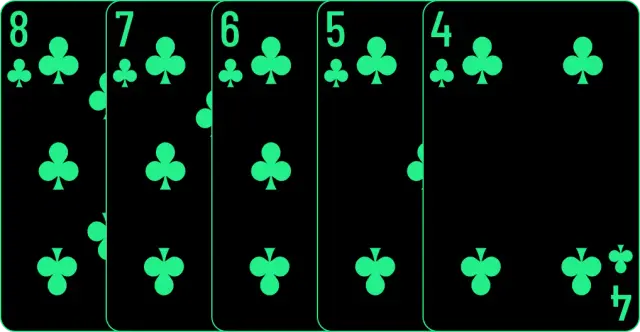
A straight flush consists of five cards in sequential order all of the same suit. Examples include 9 through king of hearts or 4 through 8 of spades. This hand combines the strength of a straight with the power of a flush making it one of the most feared holdings in the game.
Because it requires both sequence and suit the straight flush appears extremely infrequently. Starting with suited connectors gives you roughly a 0.01 to 0.02 percent chance of flopping it outright. An open-ended straight flush draw on the flop however offers solid equity of about 4 percent to complete on the turn and another 4 percent on the river. These low probabilities are exactly what keeps the straight flush at the top of the rankings.
Four of a Kind
in Poker
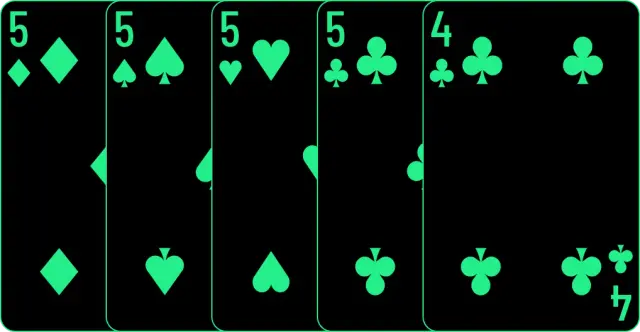
Four of a kind also called quads occurs when you hold all four cards of the same rank plus any kicker. A classic example is four aces with a king kicker. The hand delivers massive value in most situations and often prompts players to get their stacks in quickly.
With a pocket pair your chance of flopping quads sits at about 0.24 percent while improving from a set to quads on later streets reaches roughly 2.1 percent on the turn and 2.2 percent on the river. Although these odds remain low compared with everyday hands the hand still appears far more often than a straight flush which is why it ranks one step below.
Examples of Straight Flush vs 4 of a Kind
Let us look at two straightforward examples from Texas Hold’em to see the ranking in action.
Example 1
The board shows queen of clubs queen of diamonds jack of hearts 10 of hearts 9 of hearts. Player A holds queen of spades and queen of hearts for four of a kind. Player B holds king of hearts and 8 of hearts for the king-high straight flush. Despite Player A having quads, the straight flush wins the entire pot. This illustrates how a straight flush always beats four of a kind.
Example 2
The board runs out 8 of clubs 8 of hearts 7 of diamonds 6 of diamonds 5 of diamonds. Player A holds 8 of spades and 8 of diamonds for four of a kind. Player B holds 9 of diamonds and 4 of diamonds for the nine-high straight flush. Once again, the straight flush takes down the quads. These scenarios demonstrate why players must remain alert to straight-flush possibilities even when holding the powerful four of a kind.
Common Misconceptions about Straight Flush and Four of a Kind
Even strong players occasionally misjudge these rare situations. One common mistake is overvaluing quads on boards that clearly allow for a straight flush while underestimating the danger of an opponent completing the higher hand. Others play straight-flush draws too passively assuming quads cannot be beaten only to miss maximum value.
Some miscalculate implied odds in straight flush vs 4 of a kind spots and fail to build the pot aggressively enough when holding the straight flush. A smaller group incorrectly believes that certain quads are immune to straight flushes regardless of board texture which leads to expensive surprises at showdown. Recognizing these patterns helps you protect your stack and extract more value when the rare matchup occurs.
Conclusion: Is a Straight Flush Better than Quads?
A straight flush is always better than quads in standard poker games because it remains significantly rarer and therefore higher in the official hand rankings. Is a straight flush better than quads is always answered with yes in standard poker rules . This fundamental rule forms part of the essential foundation every serious player must master.
Understanding that does a straight flush beat four of a kind never changes helps you navigate even the most unusual boards with greater confidence and avoid costly mistakes. Understanding these rankings helps players make better decisions in rare showdown situations.
For more practical guides strategy breakdowns and skill-building resources explore the full library inside our Poker Academy where we turn these concepts into consistent results at the table.