



When navigating high-stakes situations on the poker felt, holding a powerful, made card combination brings immense confidence, yet tactical clarity requires an absolute certainty regarding hand rankings. A frequent point of debate among developing enthusiasts is whether a full house or flush represents the superior holding at showdown.
While seasoned professionals instinctively know the answer, verifying the underlying mechanics and probabilities explains exactly why this ranking order exists. To eliminate any immediate ambiguity: yes, a full house beats a flush under all standard regulatory rules of the game.
This comprehensive analytical guide will deconstruct the specific math, strategic nuances, and historical rarity that govern these two premium holdings.

Why Does a Full House Beat a Flush in Poker?
In poker, the standard hand rankings make it clear that any full house always beats any flush. But you might be wondering why that is.
The answer is straightforward: with two hole cards and five community cards, making a full house is noticeably more difficult than making a flush.
Like every other hand in the rankings, full houses and flushes are ordered by rarity – the rarer the hand, the higher it ranks. The exact numbers show the gap clearly:
| Hand Type | Possible 5-Card Combinations | Texas Hold’em Absolute Probability |
| Full House | 3,744 | 2.60% |
| Flush | 5,108 | 3.03% |
That means a flush is roughly 36% more common than a full house, which is exactly why the full house sits higher in the rankings.
Whenever you have a strong flush, it’s helpful to remember that full houses are meaningfully rarer. They’re not just a better hand by definition. They’re genuinely much harder to achieve. Both combinations use five cards, but while any five cards of the same suit make a flush, a full house demands far more specific cards.
In fact, a full house is so uncommon that only the very top hands, four of a kind, straight flush, and royal flush beat it in standard poker games.
If you want to see exactly how difficult these hands are to make, check out the table below that details the odds of hitting a full house or a flush on the flop, turn, and river.
| Chances To Complete on the: | Full House Realization | Flush Realization |
|---|---|---|
| Flop Stage | 0.09% – 0.98% | 0% – 0.82% |
| Turn Stage | 8.5% – 15.0% | 19.2% |
| River Stage | 8.7% – 21.7% | 19.6% |
Full House
in Poker
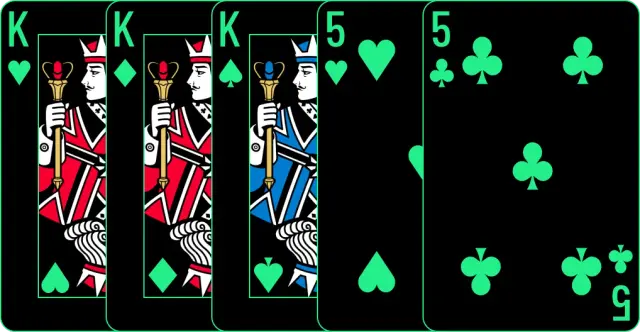
A full house is a five-card combination consisting of three cards of one specific numerical rank and two cards of another separate rank, frequently referred to in poker vernacular as a “boat.” For instance, holding three Kings and two Tens constitutes a full house, explicitly verbalized as “Kings full of Tens.”
Mathematically, the overall structural probability of drawing a full house stands at 2.60% in a standard seven-card setup. While flopping this holding natively remains rare, the probability of expanding a flopped set into a full house by the showdown rises dramatically to 36.3%.
Flush
in Poker
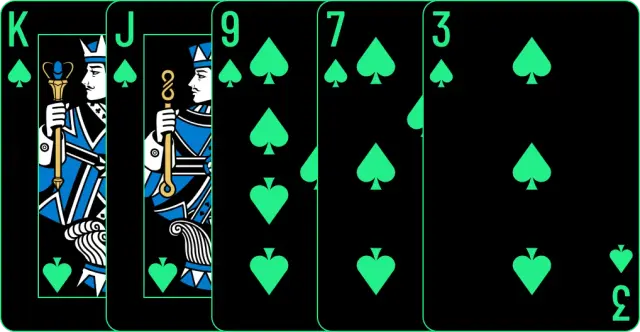
A flush is formed when a player assembles any five cards belonging to the exact same card suit, such as five spades or five diamonds, regardless of their numerical sequence. If multiple players hold a flush at a showdown, the individual possessing the single card with the highest numerical value wins the pot.
Within the structural configuration of Texas Hold’em, the mathematical likelihood of completing a flush over seven cards is 3.03%. Furthermore, if a player is holding four cards of the same suit on the flop commonly referred to as a four-flush the mathematical probability of catching a fifth matching suit card on either the turn or the river is roughly 34.9%.
Examples of Flush vs Full House
To visualize these rules clearly during a live showdown, let us review two common gameplay scenarios.
Example 1:
- Player 1 Holdings: A♦ Q♦
- Player 2 Holdings: J♠ J♥
- Community Board: K♦ 9♦ J♦ 4♣ K♠
Evaluating the ultimate five-card showdown structures reveals the following holdings:
- Player 1 (Nut Flush): A♦ Q♦ K♦ 9♦ J♦ (An Ace-high Diamond Flush)
- Player 2 (Full House): J♠ J♥ J♣ K♠ K♦ (Jacks Full of Kings)
In this scenario, Player 2 secures the entire pot. Even though Player 1 successfully executed an elite, Ace-high nut flush on the flop, Player 2’s rivered full house takes absolute priority, proving that does a full house beat a flush in poker remains an immutable rule.
Example 2:
- Player 1 Holdings: 10♠ 9♠
- Player 2 Holdings: 4♦ 4♥
- Community Board: A♠ 8♠ 4♣ A♥ 2♠
Isolating the best available combinations demonstrates the final outcomes:
- Player 1 (Flush): A♠ 2♠ 10♠ 9♠ 8♠ (An Ace-high Spade Flush)
- Player 2 (Full House): 4♦ 4♥ 4♣ A♥ A♠ (Fours Full of Aces)
Though Player 1 successfully completed a premium flush on the final river card, the paired layout of the community board allowed Player 2 to complete a full house. Player 2 wins this showdown cleanly.
Common Misconceptions about Full House and Flush
A primary error among amateur players is the psychological tendency to overvalue a completed flush, leading to severe strategic mistakes when the community board pairs.
- Board Texture Neglect: Players frequently forget that a flush is entirely safe only on completely unpaired boards, ignoring that any paired board opens the door for an opponent to hold a full house.
- Passive Play with Sets: Novices often underbet sets on the flop, failing to realize that their equity to improve to a full house warrants aggressive pot-building early on.
- Overplaying Low Flushes: Players regularly risk their entire stack with low-value flushes in multi-way pots, ignoring that is a full house better than a flush because flushes are statistically more common and highly vulnerable to superior card tiers.
Conclusion: Is Full House Better than Flush?
In conclusion, establishing whether is full house better than flush is an essential milestone that forms the bedrock of correct mathematical game theory. A full house universally outranks a flush across all high-hand poker variations, a ranking directly justified by the stricter mathematical parameters required to build it.
Memorizing this fundamental relationship prevents costly positional errors and enables accurate calculation of hand equity in complex scenarios.
For players eager to master advanced board texture analysis, precise betting strategies, and deep psychological concepts, our specialized Poker Academy provides a massive array of professional training materials to sharpen your execution.