




If you find yourself looking at the board and wondering does a flush beat three of a kind, the answer is a clear and definitive yes. A flush always beats three of a kind in standard poker games such as Texas Hold’em and Pot-Limit Omaha.
While three of a kind remains a very strong hand that wins its fair share of pots, a flush stands higher in the official poker hand rankings due to its significantly lower probability of occurring. In this guide by BC Poker, we examine the rankings, the precise odds, and the important strategic implications of this matchup.

Why Does a Flush Beat Three-of-a-Kind?
When reviewing the standard poker hand rankings chart you will see that a flush sits quite high, positioned just below the full house, four of a kind, and straight flush. Many players tend to overvalue three of a kind, especially on boards with three or more cards of the same suit. Holding a set on a wet board requires careful consideration, because an opponent may already hold a completed flush that beats your hand outright. In such cases you are usually drawing to only seven outs to improve to a full house or quads.
Understanding this ranking goes beyond simple trivia. It represents a core hand-reading skill that directly influences decision-making under pressure at the table. Although flushes can occasionally lose to higher hands they frequently serve as the best possible combination on many board textures.
In contrast, three of a kind appears far more regularly. Multiple ways exist to make trips or a set on almost any board and players turn over these hands with relative frequency during normal play.
Poker hand rankings are determined by the mathematical likelihood of making each hand from various starting combinations. This naturally places the flush above three of a kind. The table below provides a clear comparison of the chances of making each hand across the flop, turn, and river:
| Chances To Hit | Flush | Three-of-a-Kind |
| Make it on the Flop | 0% – 0.82% | 1.35% – 10.8% |
| Make it on the Turn | 19.2% | 4.2% |
| Make it on the River | 19.6% | 4.3% |
These probabilities demonstrate why does a flush beat three of a kind in poker is a fundamental rule that every serious player should understand thoroughly.
Three of a Kind
in Poker
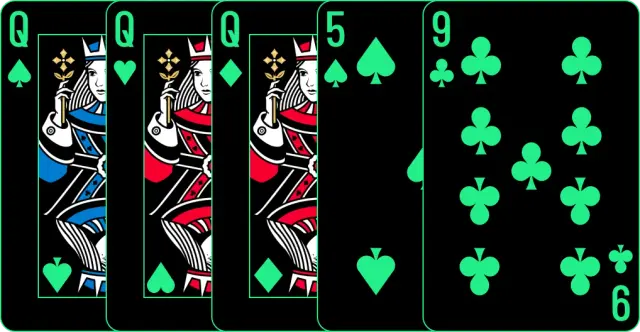
Three of a kind, often called trips or a set, consists of three cards of the same rank accompanied by two side cards. It can be made either by holding a pocket pair and hitting one more card of that rank on the board or by using two board cards together with one hole card. This hand delivers considerable strength in many situations yet it still falls below the flush in the official hierarchy.
The probability of flopping three of a kind with a pocket pair reaches approximately 11.8 percent. When starting with unpaired cards those odds drop sharply to around 1.35 percent on the flop. These figures help explain why pocket pairs are considered premium starting hands.
Flush
in Poker
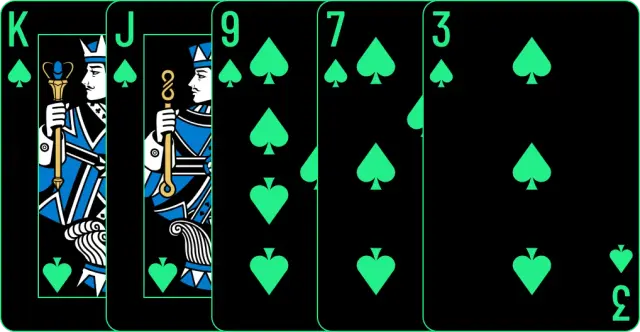
A flush is formed when a player holds five cards of the same suit regardless of their sequence. It ranks as one of the stronger hands in poker and often commands significant respect at the table.
Starting with two suited hole cards gives players roughly a 0.82 percent chance of flopping a flush. A completed flush draw on the flop offers about 19 percent equity to hit the flush on the turn and a similar percentage on the river. Although these odds remain relatively low the flush occurs more frequently than higher hands such as the full house which is why it occupies its current position in the rankings.
Examples of Flush vs 3 of a Kind
To illustrate the ranking clearly here are two practical examples from Texas Hold’em.
Example 1
The board shows A of spades K of spades 7 of spades 9 of hearts 2 of diamonds. Player A holds pocket nines for three of a kind. Player B holds Q of spades and 8 of spades for the queen-high flush. Despite Player A having a solid set the flush wins the pot. This represents a classic flush vs 3 of a kind situation where the suited hand prevails.
Example 2
The board runs out 10 of hearts 8 of hearts 5 of hearts 6 of clubs J of spades. Player A holds pocket eights for three of a kind. Player B holds A of hearts and 3 of hearts for the ace-high flush. Again the flush beats the three of a kind showing why you must remain cautious on monotone boards.
Common Misconceptions about Flush and Three of a Kind
Even experienced players sometimes misjudge these matchups. Common mistakes include overvaluing three of a kind on coordinated suited boards while underestimating the likelihood of an opponent holding a flush. Many players also play three of a kind too aggressively without properly considering flush possibilities.
Other frequent errors involve miscalculating pot odds in flush or 3 of a kind spots and calling large bets with a weak set. Some incorrectly assume that their three of a kind is safe simply because they hold the highest possible set. Recognizing and avoiding these patterns can save significant chips over the long term.
Conclusion: Is a Flush Better Than 3 of a Kind?
To answer the central question directly, yes a flush is always better than three of a kind in standard poker games. Is a flush better than 3 of a kind receives a consistent yes because the flush is generally less common than three of a kind in standard hand distributions and therefore earns its higher ranking. This ranking is a basic concept in poker hand evaluation.
Understanding that does a flush beat three of a kind influences how you bet call and fold in critical situations. It helps players make more accurate decisions in real-game situations. For additional in-depth guides strategic advice and skill development resources we invite you to explore the complete collection of materials available in our Poker Academy.