


Under the gun poker refers to the first player who must act before the flop. This seat sits in the toughest early position because every other player still has a decision behind you. At BC Poker, understanding this position helps players avoid loose opens and expensive guessing spots.
What Is Under the Gun in Poker?
If you ask what is under the gun poker, the answer starts with action order. UTG acts first after hole cards are dealt, before anyone else reveals intent through a fold, call, or raise. That is why the position feels like playing under pressure.
The under the gun meaning comes from that exact feeling: you are “under fire” before the table reacts. Everyone behind can punish weak opens with calls or 3 bets. The safest adjustment is a narrow, strong opening range.

Where Is the UTG Position at the Table?
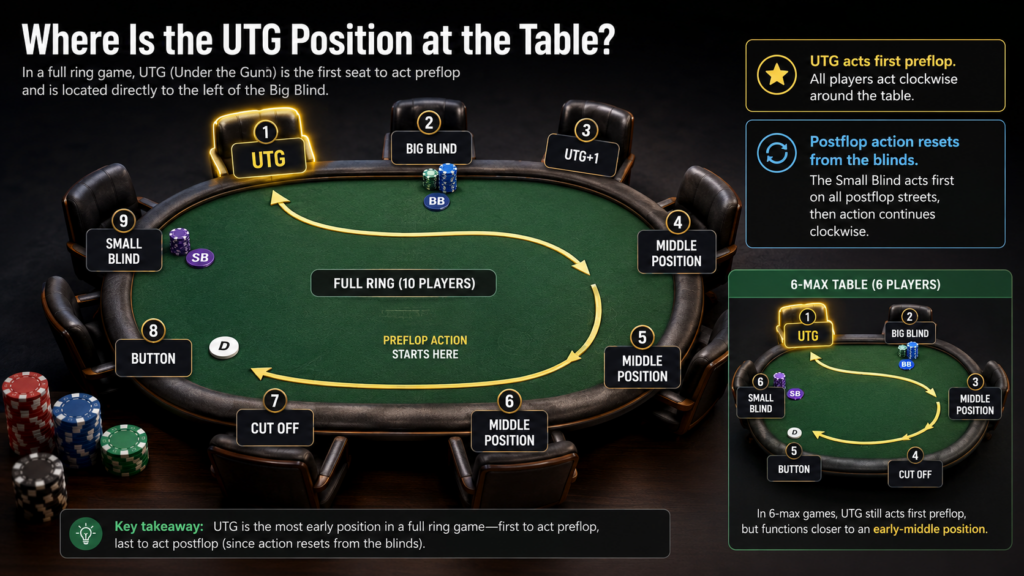
UTG sits directly left of the Big Blind and opens the preflop action. After the flop, action order resets, and the small blind or first active player left of the button acts first.
Common table order: Small Blind, Big Blind, UTG, UTG+1, Middle Position, Cutoff, Button. In 6 max games, UTG still acts first preflop, but the seat behaves closer to early middle position because fewer players remain behind.
How to Play Under the Gun
- Start with position discipline. What does under the gun mean in poker for strategy? It means you act with the least information, so your hand selection must be tighter than in cutoff or button.
- Avoid “good enough” hands. A-Q, A-J offsuit, K-J offsuit, and small suited aces can look playable, but they often run into stronger ranges. The UTG poker meaning is not just “first to act.” It also means first to make a mistake if range is too wide.
- Respect players behind you. Several opponents can still call or 3 bet. Opening weak broadways or dominated aces creates hard postflop spots, especially out of position.
- Use raises, not limps. If a hand is strong enough to play, raise it with purpose. Limping from poker UTG usually invites pressure and gives away initiative.
- Do not auto c bet every flop. A UTG raise represents strength, but low coordinated boards may connect better with callers. Choose continuation bets by board texture, not habit.
Best Hands to Open from UTG
A standard range can include 99+, AK, AQ, sometimes AJ suited, strong suited broadways such as AQs and KQs, plus selected suited connectors like T9s+ at passive tables. In 6 max, range can widen slightly, but it should still stay the tightest at the table.
Example of Playing Under the Gun
You hold AJo UTG at a full ring table. It looks strong, but eight players remain behind, and several can wake up with AK, AQ, JJ+, or a suited broadway that plays well against you. Folding may feel tight, but from this seat it often saves chips.
Common UTG Mistakes to Avoid
| Mistake | Why It Costs Chips |
| Treating UTG like late position | Early position has no information advantage, so loose opens face too much resistance. |
| Overvaluing hands like 88 or AJo | These hands play better later, where fewer players can dominate or 3 bet you. |
| Opening weak suited aces | Flush potential looks nice, but weak kicker problems create costly reverse implied odds. |
| C betting every flop | Some boards miss your strong range and hit callers better, so automatic betting burns money. |
| Limping instead of raising | Limping gives opponents cheap entry and makes your range easier to attack. |
| Ignoring table type | Against aggressive players, marginal opens get punished more often. Against passive tables, value hands perform better. |